 Fjord Compass Taco
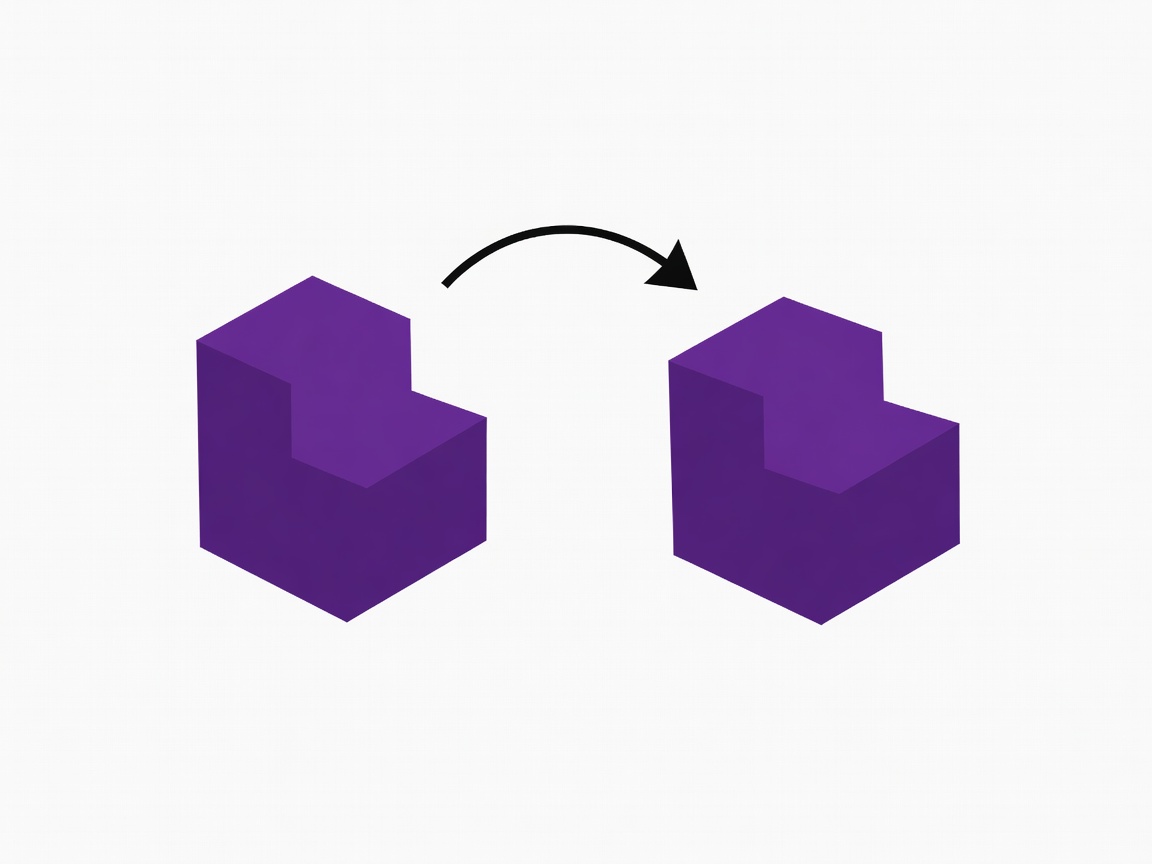
Turning things in your head
In 1971 Roger Shepard and Jacqueline Metzler published a study in Science showing people pairs of 3D block figures and asking whether they were the same object rotated, or mirror images. The time people needed grew roughly in step with the angle between the two figures, as if they were rotating a mental model at a steady pace.
That gives you a practical tip. Don't try to "see" the whole shape at once. Pick one distinctive feature, such as an odd-length arm or a single protruding block, and follow just that feature through the rotation. If it ends up somewhere the other figure doesn't have it, you've found a mirror image.
Folding: the eleven cube nets
A net is a flat pattern that folds into a solid. A cube has exactly eleven distinct nets (counting rotations and reflections as the same). Puzzle books love asking which of several patterns will fold into a cube, or which face ends up opposite which.
Worked example
Take a cross shape: a column of four squares with one square attached either side of the second. Number the column 1–4 from top, and call the side squares L and R. Fold it: square 2 becomes the base, 1 and 3 rise to become the back and front, L and R become the sides, and 4 folds over the top. Now the hidden constraint: squares two apart in a straight line end up opposite each other. So 1 is opposite 3, 2 is opposite 4, and L is opposite R. That one rule answers most "which face is opposite?" questions without folding anything.
Which patterns fail? Any net where four squares form a 2×2 block can't fold into a cube, because those four squares would need to meet at a single corner and overlap.
Tangrams, matchsticks and impossible figures
The tangram, a square cut into seven pieces (five triangles, a square and a parallelogram), originated in China and became a craze in Europe and America in the early nineteenth century. The constraint is strict: use all seven pieces, no overlaps. Hard silhouettes usually hide where the square and parallelogram sit; place those first.
Impossible figures play the opposite game: drawings that look like solid objects but can't exist. Swedish artist Oscar Reutersvärd drew an impossible triangle of cubes in 1934; Lionel and Roger Penrose described the "Penrose triangle" and an endless staircase in the British Journal of Psychology in 1958. M. C. Escher turned them into prints such as Ascending and Descending (1960) and Waterfall (1961). Each corner is locally sensible; the impossibility appears only when you trace the whole loop. That's a lovely lesson for puzzles generally: check globally, not just piece by piece.
Moving pieces: Hanoi and the Cube
Édouard Lucas published the Tower of Hanoi in 1883: move a stack of discs from one peg to another, one disc at a time, never placing a larger disc on a smaller one. The minimum number of moves for n discs is 2n − 1. Why? To move the biggest disc, you must first move the other n − 1 discs out of the way, move the big one, then move the n − 1 discs back on top. Each extra disc roughly doubles the work.
| Discs | Minimum moves | Reasoning |
|---|---|---|
| 1 | 1 | Just move it |
| 2 | 3 | 1 + 1 + 1 |
| 3 | 7 | 3 + 1 + 3 |
| 4 | 15 | 7 + 1 + 7 |
| 8 | 255 | 127 + 1 + 127 |
Ernő Rubik built the first prototype of his cube in 1974. It has 43,252,003,274,489,856,000 reachable positions, and in 2010 researchers proved that any position can be solved in at most 20 moves (counting half-turns as one move). The figure is often called "God's number". You won't find those 20 moves by intuition; solvers use memorised sequences that change a few pieces while preserving the rest.
Habits for visual puzzles
- Track one feature, not the whole shape.
- Sketch. A rough drawing beats a perfect mental image.
- Use paper or real objects: fold the net, cut the tangram.
- Look for rules like "opposite faces" that replace imagining with counting.
- Trace impossible figures all the way round before trusting any corner.
Stuck on a fold or a rotation? Describe it on WhatsApp or continue to Rethink the Premise.
Sources
- Shepard, R. N. & Metzler, J. "Mental Rotation of Three-Dimensional Objects." Science 171 (1971). Overview
- Penrose triangle · Tower of Hanoi · cube20.org: God's number is 20